Staff at large chain shops in Beijing and Shanghai can manage basic communication; most wholesale markets have no English. Come prepared with a phone translator and a prescription keyword card, and it goes more smoothly than you expect.

Short Answer First
Short answer: it depends on the place. Chain optical stores in business districts such as Shanghai West Nanjing Road, Beijing Guomao, Shenzhen MixC and Chengdu Taikoo Li (Bao Dao, Doctor Glasses, LensCrafters cooperation stores) generally have young staff with basic English, and optometrists mostly have experience with English prescriptions. But if you head straight to wholesale markets like Beijing Panjiayuan, Danyang Glasses City or Shenzhen Henggang, 90% of stall owners speak only Mandarin — no English, not even pinyin.
The steadiest approach for foreign travelers: go to a large chain in a foreigner-friendly business district, install translation apps on your phone, and save a screenshot of a “prescription keyword card” beforehand. The whole process takes 1–2 hours with same-day pickup; a pair costs RMB 200–500 (about USD 28–70) in Shanghai, a big saving off the US average of USD 234. This price and process are broken down on getting-glasses-in-china.com.
Below we cover where English works, where it doesn’t, how to use translation tools, and how to write the keyword card.
1. How Good Is the English at Chain Optical Shops?
Chinese chain optical shops fall into tiers with very different English ability.
Tier one: flagship stores in foreigner-heavy business districts. Places like Shanghai West Nanjing Road and Huaihai Road, Beijing Sanlitun and Guomao SKP, Shenzhen MixC, Chengdu Taikoo Li deliberately station one or two staff with decent English. They can handle: which frame you want, your degree, whether you need anti-blue light, pickup time and card payment. Optometrists are steadier here because exam machines carry English interfaces and trial fitting relies on gestures plus the two words “clear” and “blurry.”
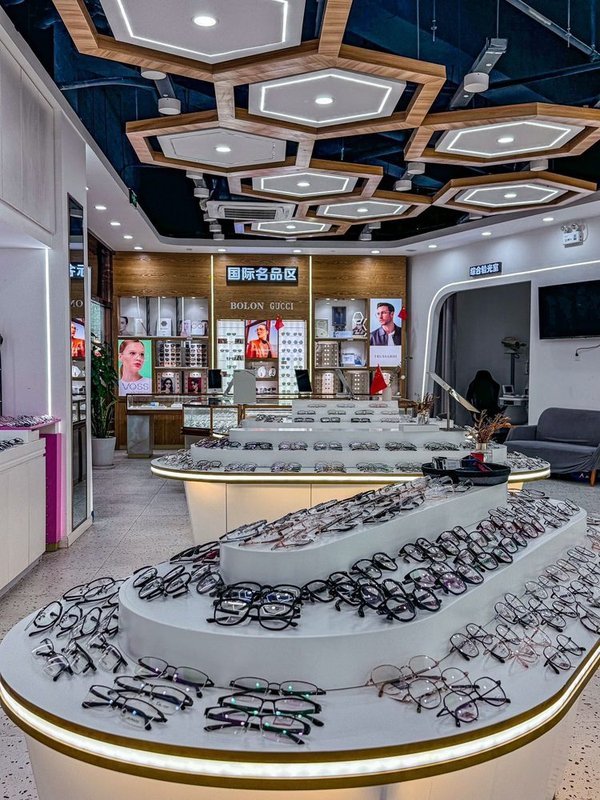
Tier two: standard chains in ordinary malls. Bao Dao, Doctor Glasses, Daming, LensCrafters-type shops inside shopping centers. Staff are in their twenties with CET-4/6 level; they can produce words but assemble sentences slowly. Speak slowly, use phone translation, and the flow mostly doesn’t stall. An older store manager may have zero English but will proactively call a younger staff member over.
Tier three: hospital vision centers. At places like Beijing Tongren or Shanghai Eye, Ear, Nose and Throat Hospital, queues start at 2 hours, but English isn’t the issue: doctors only do exams, not sales, and machines are fully English. However, getting examined at a hospital then fitting elsewhere costs too much time; not recommended for travelers. The hospital exam fee is RMB 50–150 (about USD 7–21), and you then carry the prescription elsewhere, losing half a day round trip.
Tier four: e-commerce offline experience stores. JD Jingzao and Mijia Youpin experience stores inside malls carry transparent pricing with younger staff, slightly better English than traditional chains, but a narrow lens selection; high degrees and special lenses can’t be handled.
Fact: English service in China’s eyewear industry was not “trained” so much as “practiced on foreign customers.” A shop in an old-town alley hanging a “30-year establishment” sign likely has an owner with poor English, even with strong exam skills. Conversely, in Korean- and Japanese-ethnic enclaves such as Shanghai Gubei or Beijing Wangjing, shop owners may know a little Japanese or Korean but only average English — because their regular customers aren’t English-speaking.
How to judge a shop’s English before entering? Glance around: is there an English price list on the wall? Are English lens packages (original Essilor, Zeiss, Nikon boxes) on shelves? Is there a Visa/Mastercard sticker by the register? Two of three means the shop has served foreign customers before; none means prepare for gesture communication.
2. Which Business Districts Are Most Friendly to Foreign Travelers?
Shanghai:
- West Nanjing Road (Plaza 66, Hang Lung, CITIC Pacific): Bao Dao, LensCrafters, Puyi Optical all present; staff English up to standard.
- Middle Huaihai Road (IAPM, K11): many white-collar foreign-company workers; staff are used to foreigners.
- Lujiazui ifc: concentrated expats in the financial district; mall optical shops run high service standards.
Beijing:
- Guomao Mall, SKP: luxury eyewear floors with the best English service, but the highest prices.
- Sanlitun Taikoo Li: young customer base; Doctor Glasses and Bao Dao both have branches.
- Wangfujing: tourist area with clear pricing but slightly pricey.
Shenzhen:
- MixC, MixC World: chain optical shops clustered; staff English averages among the nation’s best (many foreign companies in Shenzhen).
- Coastal City: fewer tourists, prices somewhat firmer.
Chengdu:
- Sino-Ocean Taikoo Li, IFS: the highest expat density in southwest China; full range of large chains.
- Chunxi Road: tourist area, little haggling room.
A counter-intuitive tip: don’t buy at the optical shop next to the hotel lobby. Shops beside hotels target tourists specifically, charge about 20% more than the same brand two streets over, and often have only average English — they live on location, not service.
Weekday vs. weekend: visit Tuesday to Thursday morning when the shop is empty and staff have time to gesture through things. Saturday afternoon and all Sunday are peak hours for local family fittings; staff are too busy to attend you, and language gaps make perfunctory service more likely. Holidays such as the National Day week and the week before Spring Festival mean 40-minute queues even at large chains, optometrists rush, and communication quality drops.
Don’t arrive in the last hour before mall closing. Staff rush off work and compress exam, grinding and fitting into 40 minutes, raising the chance of defects. The best slot is a weekday morning at 10 o’clock opening; you are the first customer of the day.
3. How to Use Translation Tools Reliably
A few points matter when using translation tools in China.
Google Translate: the web version and app are blocked most of the time and need a VPN. If you haven’t installed a VPN profile beforehand, you basically can’t connect after landing on China Mobile network. Don’t put all your eggs in Google Translate.
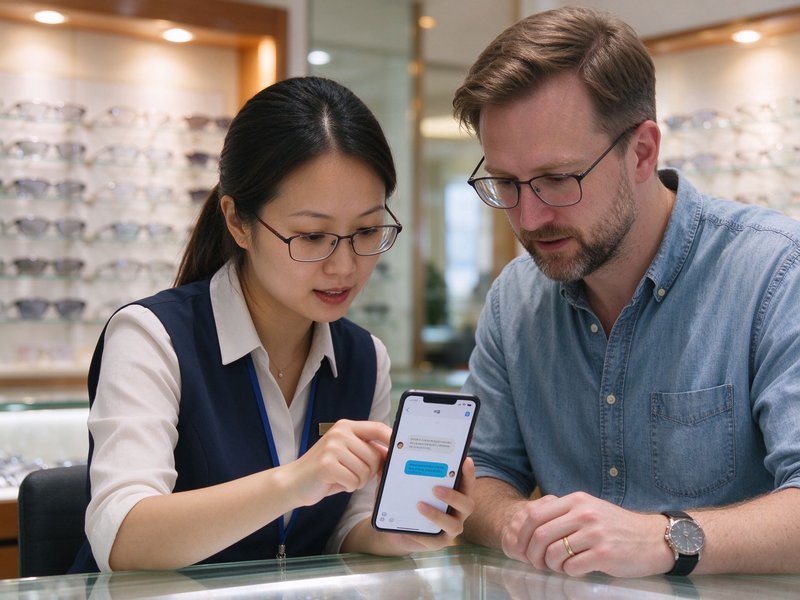
Baidu Translate: opens directly inside China with high Chinese recognition; good for photo translation of menus and lens packaging. Its weakness: Chinese-to-English is stronger than English-to-Chinese. To show staff your English degree, it converts the phrase “myopia 400 degrees” into the Chinese degree wording staff can read.
iFlytek input method / translator: voice translation is the strength. You speak English, it outputs Chinese voice and text that staff can hear directly; suited to back-and-forth scenes like the eye exam.
WeChat “Scan” translation: seriously underrated. Inside the WeChat scan entry there is a translation feature; point it at a lens package, price list or prescription and the whole English block outputs Chinese. No new app needed; everyone has WeChat.
Practical advice: before departure on hotel Wi-Fi, download Google Translate’s Chinese offline pack. If offline in the shop, the pack still works. Install and register Baidu Translate and iFlytek in advance; don’t download in the shop — domestic app downloads in Chinese malls require an SMS verification code your overseas number can’t receive.
A counter-intuitive point: Chinese staff’s English listening is better than their speaking. Speak slowly, use simple words and gesture; they understand. When they have to reply, they stumble. So skip full sentences and use keywords: “minus three,” “PD 62,” “today.”
⚠️ One detail: lens packaging carries a stack of English parameters (index 1.67, aspheric, blue cut, photochromic), and translation apps often mangle them. Don’t rely on translation here; read the numbers directly — 1.67 is the index, -3.00 is the degree, PD 62 is the pupil distance. These numbers are universal.
Network contingency: public mall Wi-Fi in China requires a phone-number verification your overseas number can’t receive. Buy a local SIM at the airport counter (RMB 50–100) beforehand, or activate your carrier’s international roaming data package. Translation apps all need network support.
4. Gestures + Your Old Glasses: a Zero-Language Plan
Here’s another trick.
Show your old glasses. This is the optometrist’s secret weapon. Hand your current glasses to the optometrist; with a lensometer (a small instrument, 5 seconds) it reads out degree, astigmatism and axis of your pair. Accuracy above 95%.
Eye exams at Chinese optical shops are free, 15–30 minutes. Even without a word of Chinese, you can complete the exam flow:
- Sit at the machine and look at the small house inside (autorefraction).
- Switch to trial frames, read the eye chart, point direction (up/down/left/right gestures suffice).
- When the optometrist asks “clearer or about the same?” nod or shake your head.
- They write a Chinese prescription; you take a photo.
Frame selection: pointing throughout. Point at a frame you like; staff hand it to you to try. Frame price tags show numbers you can read. Lens price lists also carry numbers and English parameters (index, aspheric, blue cut) that need no translation.
Payment: large shops take card scan or QR directly. Show your overseas Visa/Mastercard; the cashier runs the POS machine. Wholesale markets require cash; withdraw RMB at an ATM beforehand.
Pickup: grind glasses are handed over; you put them on and look in the mirror. If dizzy, the ground looks convex or book text blurs, shake your head and point at your eye; the optometrist will readjust. No language needed in this step: uncomfortable try-on means shaking your head, and staff understand. In the standard Chinese same-day pickup flow, a 10-minute try-on is built in; even if you don’t speak up, staff will have you walk around to adapt.
⚠️ Tip: enter and first point at your own eye, then point at the shelves — staff understand “this person needs glasses.” A Chinese optical shop serves 30 customers a day, five of whom don’t speak (elderly, out-of-town visitors, deaf-mute); staff are long used to gesture communication. You are not the first.
⚠️ Last word: in China, language really isn’t the biggest barrier to buying glasses. The biggest barrier is not knowing what you want. Settle degree, PD, index and whether you need anti-blue light, then leave the rest to machines and gestures.
Bottom-line advice for completely unprepared travelers: empty-handed, no apps installed, passing through and wanting a pair. Walk straight into a large chain flagship on Shanghai West Nanjing Road or Beijing Guomao; look for the Visa/Mastercard sign by the register. If present, enter. Sit down, hand over your phone, open Google Translate voice conversation mode, say “glasses, prescription here,” and show staff your home prescription (saved in your phone album). They will walk you through the rest. The full process takes 2 hours, RMB 200–500 (USD 28–70).
FAQ
Q: I don’t speak a word of Chinese — can I get proper glasses in China?
Yes. At chain flagships in Beijing Guomao and Shanghai West Nanjing Road, staff can basically complete the full glasses process in English. Exam machines carry English interfaces, frame selection relies on pointing, payment is card or QR. The only advance prep: install Baidu Translate and iFlytek on your phone, and save a keyword card of your old glasses degree. The whole process takes 1–2 hours with same-day pickup.
Q: Does Google Translate work in China?
Mostly not directly; it needs a VPN. Before departure on hotel Wi-Fi, download the Chinese offline pack so it works offline after landing. Domestic alternatives are Baidu Translate (strong photo translation) and the translation feature inside WeChat Scan, neither needing a VPN.
Q: Will foreigners be ripped off at markets like Panjiayuan?
Yes, at a decent rate. Stall owners raise quotes 30–50% above locals once they see a foreign face, and without language you can’t even haggle. A September 2026 Henggang spot check found 5 of 8 shops selling luxury fakes, targeting foreigners as main customers. Either bring a Chinese-speaking friend, or pay USD 10–20 more at a large chain for peace of mind.
Q: Can I fit glasses with my home prescription without bringing old glasses?
Yes, but the prescription must carry SPH (sphere), CYL (cylinder/astigmatism), AXIS (axis) and PD (PD). Missing PD is fine; Chinese shops measure it free in 1 minute. Missing astigmatism axis is troublesome and requires an in-store re-exam. We suggest a free on-site re-exam anyway in 15–30 minutes rather than forcing an old prescription. Don’t directly use prescriptions over 3 years old; degrees may have changed and over-correction causes dizziness.
Q: The optometrist doesn’t speak English — how do I communicate “clearer”?
Gestures and keywords. Each time the optometrist swaps a trial lens and asks “clearer?” you nod or shake your head. Or save three words on your phone beforehand: “clear,” “blurry,” “about the same.” Chinese optometrists serve 20 customers a day; gesture communication is basic skill. Don’t worry they won’t understand.