Conclusion: lenses are neither better the more expensive nor higher index the better. Match index to prescription: 1.56 under 300 degrees, 1.60 for 300–600, 1.67 for 600–800, and 1.74 only above 800. Ordinary travelers are fine with domestic brands (MingYue, WanXin, Huiding); a complete pair for RMB 200–500 (about USD 28–70) is reasonable. Don’t pay extra for words like “ultra-thin” or “imported.”
1. What Is Refractive Index Exactly?
Refractive index is the parameter describing a lens material’s light-bending power. Higher numbers yield thinner lenses for the same prescription, but it is not “higher is better,” because there is a hidden trade-off — Abbe number.
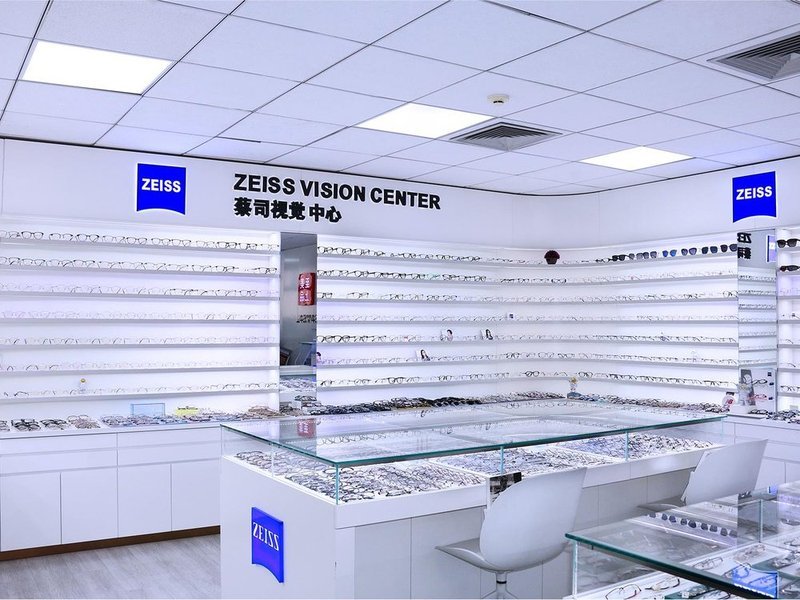
- 1.56: Abbe number about 36, low dispersion, most comfortable vision, cheap.
- 1.60: Abbe number about 33, moderate thickness, best value for money.
- 1.67: Abbe number about 32, thinner, but dispersion starts to show.
- 1.74: Abbe number about 32, thinnest, but highest dispersion; long wear can cause visual fatigue.
What is dispersion? Put simply, colored fringes appear around the edges of objects, especially when looking at bright light, white walls or white paper. The lower the Abbe number, the stronger this effect.
⚠️ Double 11 live rooms love pushing 1.74 because unit prices and commissions are high. If you wear -3.00, choosing 1.74 means spending RMB 1500 extra on a parameter you don’t need, while sacrificing visual quality.
Why does higher index mean lower Abbe number? Material physics decides it: high-index lenses use denser glass or resin molecules, producing a bigger bending difference across wavelengths. Science cannot simultaneously achieve high index and high Abbe number; this is a trade-off.
Are ordinary people sensitive to dispersion? Most aren’t; during daily computer work, walking and driving it’s imperceptible. Two groups notice clearly: visual professionals (designers, photographers) who demand accurate color reproduction, and high-myopia users with long screen hours — dispersion stacks on eye fatigue, giving headaches after a full day.
✅ Don’t be fooled by the word “ultra-thin.” Lenses get replaced every 1–2 years; being 1mm thinner adds little to daily life, while the extra money is real cash out of pocket.
2. Index-to-Prescription Reference Table (save this one)
| Prescription range | Recommended index | Price per lens (RMB) | Approx. USD | Suited to |
|---|---|---|---|---|
| Under 300 degrees | 1.56 | 100–200 | 14–28 | Mild myopia, tight budget |
| 300–600 degrees | 1.60 | 200–400 | 28–56 | Most people, the sweet spot |
| 600–800 degrees | 1.67 | 400–800 | 56–112 | High myopia, wanting thin |
| Over 800 degrees | 1.74 | 800–2000 | 112–280 | Very high myopia |

Why this mapping? Using a high index for low myopia produces a thickness difference you can barely see, at several times the price. Using a low index for high myopia leaves edges as thick as a bottle bottom, pressing the nose bridge and looking bad.
✅ A practical check: hold your current glasses sideways and look at the edge. If thickness is already clearly visible, it’s time to step up an index. If the edge is still thin, no extra payment needed.
Account for astigmatism too. This table is based on sphere (myopia degree). If astigmatism exceeds 200 degrees, edges run thicker than for the same sphere without astigmatism; step up one index from the recommendation. For example, -4.00 myopia plus -2.00 astigmatism: choose 1.67 rather than 1.60.
PD also affects thickness. People with a small PD (common 58–60mm for women) need the optical center shifted inward, increasing edge thickness. People with a larger PD (common 64–66mm for men) have relatively thin edges. If your PD is under 60mm, don’t choose an oversized frame; no index can rescue that.
3. Choosing Coatings: Standard vs. Expensive Extras
Lens coatings come in layers; Double 11 packages describe them in many ways.
Hard coating (must-have): all proper lenses include it by default; it resists scratches. A lens without hard coating is full of scratches after half a year; don’t buy glasses from a shop that skips it.
Anti-reflective coating (must-have): reduces reflections and cuts glare from oncoming headlights at night. Standard on proper lenses.
Anti-blue-light coating (optional): blocks short-wave blue light from screens. Suited to people who stare at screens 8+ hours a day. But anti-blue lenses carry a yellowish base that distorts color and makes eyes look blue in photos.
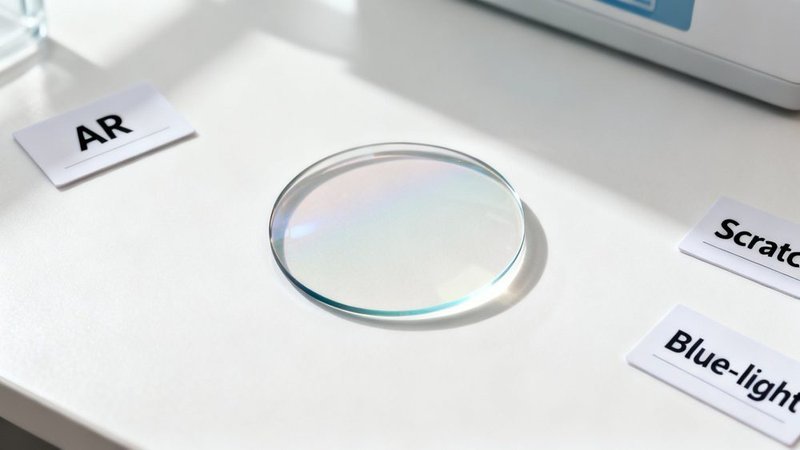
Photochromic lenses (optional): clear indoors, darken outdoors under UV. Suited to people outdoors often who don’t want two pairs. RMB 300–500 (about USD 42–70) more than ordinary lenses.
⚠️ Note: photochromic lenses do not darken inside a car (the windshield blocks UV). If you mainly wear them driving, skip them.
Polarized lenses (for drivers / cyclists): filter reflections from roads and water; suited to driving, fishing, cycling. Ordinary myopia users don’t need them.
Common coating myths:
- Myth one: “more coatings are better.” Wrong. Each extra layer cuts light transmission 1–2%. Three to four layers are enough on proper lenses; claims of ten layers are basically marketing.
- Myth two: “anti-blue light prevents myopia.” Wrong. Anti-blue has no direct link to myopia progression. Myopia control relies on 2 hours of outdoor activity per day, low-concentration atropine and ortho-K lenses, not lens coatings.
- Myth three: “photochromic lenses never fade.” Wrong. Photochromic lifespan is 1–2 years; after that darkening and fading slow down, and lenses end up grayish indoors. A RMB 99 photochromic lens fails within half a year.
✅ Suggestion: ordinary users are fine with a basic hard + anti-reflective coating. Add anti-blue based on work, photochromic on outdoor need, polarized on driving habits.
What is “full-function coating” in a Double 11 package? Usually hard + anti-reflective + anti-blue + anti-smudge bundled at RMB 200–300 extra. It sounds like a deal, but you only need the first two. Anti-blue carries a yellow base and looks bad in photos; anti-smudge coating fades after half a year.
4. Brand Markup: Domestic vs. Imported, Where the Difference Lies
The biggest Double 11 price trap is brand markup. At the same index, domestic and imported lenses differ 3–5 times in price, yet the actual wearing experience does not differ by that much.
Top domestic brands:
- MingYue: largest domestic market share; the PMC Super Bright series has a strong reputation, 1.60 at RMB 200–300 per lens.
- WanXin: long-standing value brand, 1.60 at RMB 150–250 per lens.
- Huiding: rising in recent years with fast coating improvements, 1.60 at RMB 180–280 per lens.
Imported brands:
- Zeiss (Germany): benchmark optical precision, 1.60 Lotus coating RMB 800–1200.
- Essilor (France): Crizal coating series, 1.60 RMB 700–1000.
- Hoya (Japan): 1.60 RMB 600–900.
Where does the 3–5x price gap come from?
- Optical uniformity: imported edges image better; the gap is visible on large frames.
- Coating durability: imported coatings resist smudge and scratches for 2–3 years; domestic for 1–2 years.
- Authentication systems: imported have mature anti-counterfeiting codes and fewer fakes.
- Brand: you pay 20–30% extra for the logo.
✅ Foreign traveler advice: for ordinary single-vision glasses, a domestic MingYue PMC 1.60 is fully adequate. Wear 1–2 years then replace; there’s no need for Zeiss unless you are a designer or photographer who demands high color fidelity.
How to decide whether you need imported? Ask yourself three questions:
- Do your current glasses show distorted vision at the edges or color casts?
- Do you wear glasses more than 10 hours a day?
- Did you choose an oversized frame (52mm+ lens width)?
If all three are “yes,” consider Zeiss/Essilor. Otherwise a domestic product from China suffices.
2026 quality warnings:
- October 2026: Laifu Glasses in Siming District, Xiamen was filed for selling counterfeit children’s myopia-control lenses.
- October 2026: four Danyang companies were filed for non-compliant labeling and false advertising.
These cases show that even choosing a “domestic brand,” you must buy through proper channels; don’t buy cheap no-name goods at wholesale markets.
How to identify no-name lenses? Three signs:
- The bag has no clear brand logo, only an English name with no website to find.
- No anti-counterfeiting code, or scanning it redirects to an unknown page.
- Staff say “our lenses share a factory with Zeiss” but cannot produce a Zeiss authorization letter.
🚫 August 2026, glasses market near Beijing Panjiayuan: of 10 pairs submitted, only 1 passed; “UV400” labels were mostly fake stickers. Fake share runs even higher at such places during Double 11 volume pushes.
✅ Remember: lenses sold at chains (Bao Dao, Doctor Glasses, LensCrafters) — even domestic MingYue — come through proper channels. Wholesale markets are 30% cheaper but carry high fake risk. Your time is precious; don’t gamble.
5. Lenses You Should Not Buy During Double 11
Two lens categories carry small Double 11 discounts and many traps; fit them through proper channels at normal times.
1. Progressive Multifocal Lenses (reading + distance in one pair)
Prices are transparent, with only 5–10% off during Double 11. But the fitting process is complex: it requires measuring distance and near vision, pupil height and PD; after fitting there is a 1–2 week adaptation period with 2–3 return visits for adjustment. During Double 11 queues, you traveling abroad simply can’t make those visits in time.
Another progressive trap: brands differ in design. Once adapted to Zeiss progressive, switching to Essilor progressive needs re-adaptation. Low-price progressive links sold during Double 11 often use no-name designs with narrow fields and distorted vision, causing dizziness after a week.
2. Children’s Myopia-Control Lenses (such as Zeiss MyoCare, Essilor Stellest)
These lenses carry medical characteristics and must be fitted at a hospital vision center or authorized fitting point. In October 2026, Laifu Glasses in Siming District, Xiamen was filed for selling counterfeit children’s myopia-control lenses. Low-price Double 11 online links carry a very high fake risk.
The core technology of children’s myopia-control lenses is “peripheral defocus”; genuine units can slow myopia progression 30–50%, while fakes are no different from ordinary lenses. Paying but watching a child’s degree keep rising is the biggest waste.
✅ Suggestion: skip the Double 11 discount for these two categories. Go to a proper hospital ophthalmology department or an authorized chain store; paying 20% more buys peace of mind.
6. Choosing Frame Materials
Frame material differences in Double 11 packages strongly affect wearing experience.
- TR90: lightest and cheapest, RMB 50–150 (about USD 7–21), drop-resistant, suited to sports and spares. Downside: loosens after a year.
- Acetate: good texture, wide color range, RMB 150–400 (about USD 21–56), daily wear. Downside: relatively heavy.
- Pure titanium: light, hypoallergenic, fade-resistant, RMB 300–800 (about USD 42–112), suited to long wear. First choice for foreign travelers.
- Alloy: cheap but fades and triggers allergies easily, RMB 50–200; the “any frame” in Double 11 packages is mostly this.
🚫 Trap: many “pure titanium frames” are actually “titanium alloy” or “beta titanium,” costing half as much. Ask clearly at ordering whether it’s “pure titanium” or “titanium alloy.” In a pure titanium frame, nose pads, temples and screws are all titanium; in alloy only some parts are.
✅ Foreign traveler frame advice: pure titanium + domestic 1.60 lenses is the value sweet spot. A complete pair at RMB 300–500 (about USD 42–70), light, durable and hypoallergenic, works fine for two years back home.
How to choose frame size? Three numbers on the inner temple, such as “52□18-140”: 52 is lens width, 18 bridge width, 140 temple length. Foreign travelers generally have higher bridges and longer faces; 54□18-145 fits better. The standard domestic 52□17-140 may pinch European faces.
⚠️ Don’t buy a frame online and then bring it for lenses. A mismatched frame pinches temples or slides down, and staff can barely adjust it on the spot. Best to try on in store for 5 minutes, confirming no pinching, no sliding and comfortable nose-pad fit, before ordering.
7. On the Day of Pickup: How to Inspect
The lenses are ready. Run these checks on the spot:

- Put them on and walk a few steps: check the ground looks flat and stair edges aren’t distorted.
- Read phone text: check for double vision or blur.
- Read distant road signs: compare with old glasses for any drop in clarity.
- Check lens edges: look for bubbles, scratches or uneven polishing.
- Cross-check packaging: compare brand, index and degree with the order.
Raise any issue on the spot.
Special reminder for foreign travelers: same-day pickup is the norm in China. The six-step process totals 1–2 hours: browse the market for a frame 10–20 minutes → free exam 15–30 minutes → choose lenses and confirm 20–40 minutes → pay 5–10 minutes → on-site grinding 20–60 minutes → try on and collect 10 minutes.
✅ If dizzy at inspection: don’t endure it. Say “I feel dizzy, can you check again?” Staff will recheck degree and PD. 90% of discomfort comes from an unadjusted frame angle, fixable in 5 minutes.
🚫 Don’t: leave the shop with new glasses and walk 1 kilometer before noticing dizziness. Walk back and staff may say “the adjustment period has passed.” Try on for 5 minutes in store, walk around twice, and leave only after confirming everything is fine.
8. Easy Double 11 Glasses Traps
Trap 1: only looking at the “Double 11 price,” not whether the original price was inflated. Fix: search the same model on Dianping for the normal transaction price.
Trap 2: staff say “your prescription really needs 1.67/1.74.” Fix: use the table yourself; under 300 degrees, 1.56 is enough.
Trap 3: package says “anti-blue light” but no brand or model. Fix: demand the full line “MingYue PMC 1.60 anti-blue”; go to another shop if they won’t write it.
Trap 4: ordering online when abroad, unable to collect lenses. Fix: under a 5-day trip, don’t order online; offline same-day pickup.
Trap 5: skipping authentication at pickup and discovering fakes at home. Fix: open bags in person, scan codes to verify; for Zeiss, breathe on the lens for the ZEISS mark.
Avoid these traps and a Double 11 glasses purchase basically won’t go wrong. Remember the big principle: you are fitting glasses in China, not in Europe or America. Normal Chinese prices are already 70–90% below Europe and America; don’t gamble on fakes and tricks just to “save a little more.”
Final line: the core of Double 11 glasses is not “grabbing the lowest price” but “getting glasses that fit.” A good pair worn two years spreads its daily saving far beyond the time wasted chasing a RMB 50 discount. Don’t penny-wise and pound-foolish.
FAQ
Q1: I’m -2.00; the staff pushes 1.67 saying “thinner looks better” — should I listen?
No. At -2.00 a 1.56 lens already looks thin; the visible difference to 1.67 is under 0.5mm, while the price rises RMB 300–500. Only consider stepping up if you chose an oversized frame with genuinely thick edges.
Q2: Anti-blue lenses feel more comfortable for my eyes — does that mean they work?
Not necessarily; psychology accounts for a large share. Current research evidence for anti-blue coatings relieving eye strain is unclear. What genuinely works is the 20-20-20 rule: every 20 minutes look at something 20 feet (about 6 meters) away for 20 seconds.
Q3: Can foreign travelers fit glasses in China directly with an overseas prescription?
Yes. The prescription must carry SPH (sphere), CYL (cylinder), AXIS (axis) and PD (PD). Chains honor prescriptions within 3 months; beyond 3 months, we suggest a free on-site re-exam in 15–30 minutes.
Q4: What to watch for when redeeming Tmall-purchased lenses at a store during Double 11?
First clarify whether the redemption price includes grinding and processing fees and the frame. Some packages cover lenses only, with frames chosen and paid separately. Open lens packaging in person at redemption, scan to verify; don’t let staff open it beforehand.
Q5: Do photochromic lenses look grayish indoors?
Proper photochromic lenses are nearly clear indoors with only a faint base color. Cheap inferior ones look grayish indoors like wearing sunglasses. A RMB 99-or-below photochromic lens is likely the latter.